
Buyer Fit at a Glance
Most guides push stitch count first. That is the wrong filter here. The M3220 earns its place when the goal is to finish ordinary jobs quickly, not when the goal is to collect functions you never touch.
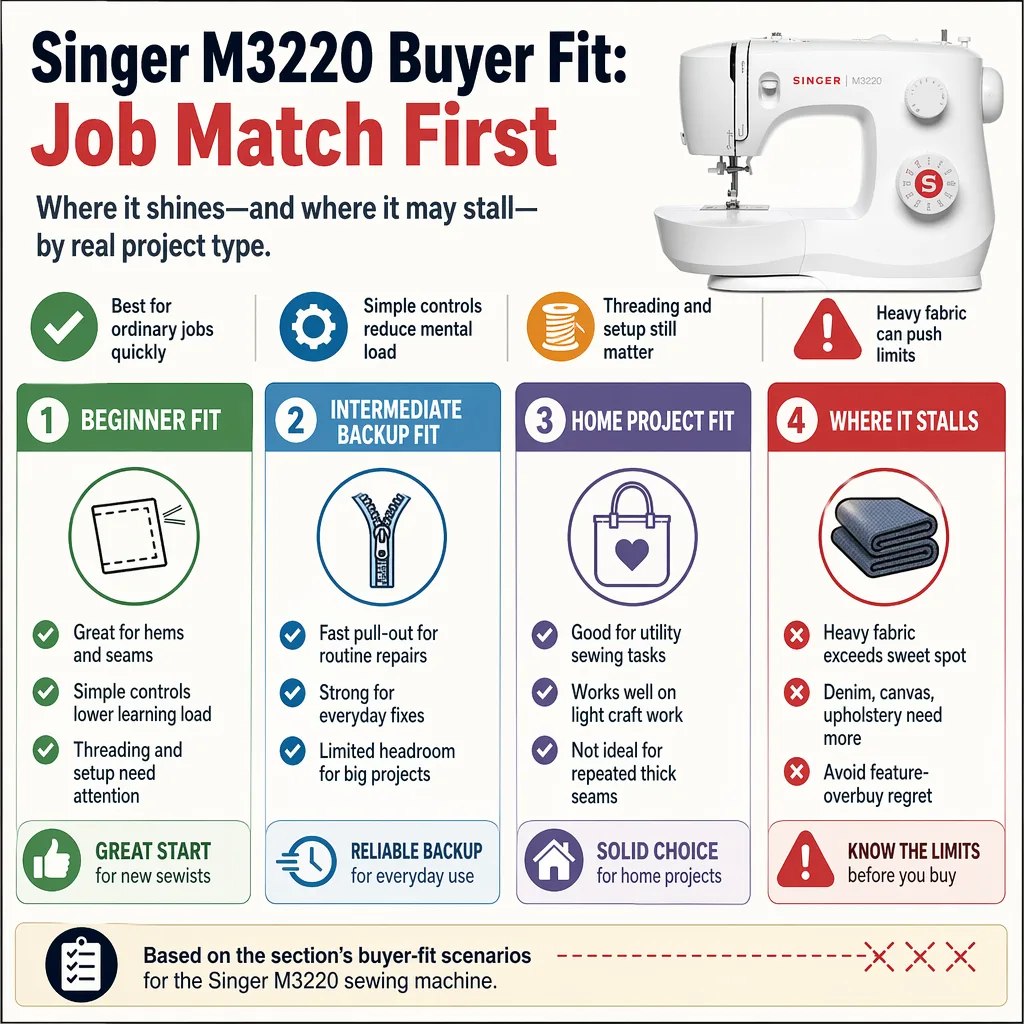
| Buyer scenario | Fit | Why it works | Where it stalls |
|---|---|---|---|
| Beginner learning hems and seams | Strong | Simple controls lower the mental load. | Threading and setup still require attention. |
| Intermediate sewer needing a backup machine | Strong | Quick to pull out for routine repairs. | Limited headroom for bigger projects. |
| Light home projects and craft work | Good | Handles basic utility sewing without extra complexity. | Not the right pick for repeated thick seams. |
| Denim, canvas, or upholstery work | Poor | Simple machines stay easy to understand. | Heavy fabric pushes this class past its sweet spot. |
The real appeal is not flash. It is avoiding the common regret that comes from buying a machine with more features than your projects need, then spending extra time learning menus instead of sewing.
What This Analysis Is Based On
This is a structured buyer-fit read built around the M3220’s place in Singer’s lineup, the kind of sewing it serves, and the friction points budget machines create after checkout. The focus stays on setup burden, project range, and the point where a simpler machine stops paying for itself.
Robot or human?
Human-LED. The M3220 keeps control in the sewer’s hands instead of hiding it behind a screen, which lowers the learning curve and keeps the machine straightforward for repairs. The trade-off is more manual decision-making, so thread setup and stitch selection matter every time.
That matters because simple machines do not solve beginner mistakes for you. They expose them. A skipped step in threading, tension, or needle choice shows up fast, and that is useful for learning, but it also means there is less room to brute-force a sloppy setup.
Who It Fits Best
Best-fit scenario A beginner who wants one machine for hemming pants, fixing seams, making pillow covers, and learning basic control without a complicated menu.
The M3220 fits three buyer groups best.
- First-time sewists who want a clear path into everyday sewing without a steep setup burden.
- Intermediate users who already own a main machine and want a lighter-duty backup for quick jobs.
- Budget-minded DIY buyers who care more about getting useful stitches than about decorative extras.
The trade-off is ceiling, not comfort. It stays friendly as long as the work stays ordinary. Once projects ask for thicker fabric, denser seam intersections, or more convenience features, the machine stops feeling like a bargain and starts feeling narrow.
Where It May Disappoint
Caution
- Thick denim, canvas, and layered seam crossings raise the difficulty fast.
- Simple machines expose setup mistakes, they do not hide them.
- Cheap listings with missing accessories erase the savings.
Most beginners blame the machine when the real problem sits in threading, bobbin setup, or needle choice. That matters here because the M3220 rewards careful setup, not shortcuts. If the goal is a machine that removes decisions, a computerized Singer belongs higher on the list.
Accessory planning deserves attention too. Low-cost machines lose value quickly when the included feet, bobbins, or manual are incomplete, because replacement parts turn a small bargain into a scavenger hunt. A stripped-down open-box listing is not the same purchase as a complete one, even when the sticker looks better.
The Next Step After Narrowing Singer M3220 Sewing Machine
If the M3220 is close but not quite enough, the next step depends on where your frustration sits. The right move is not always a more expensive machine. The right move is the machine that removes the exact problem you already feel.
Move up to a Singer Heavy Duty model when fabric gets heavy
A Singer Heavy Duty model belongs on the shortlist for denim hems, tote bag seams, canvas projects, and layered repairs. That choice gives up some simplicity, but it pays off the first time a basic machine starts asking for slow hand-guiding through a thick seam.
This is the right upgrade when the fabric itself causes the annoyance. Stitch variety matters less than control under load.
Stay with the M3220 when simplicity matters more than range
The M3220 fits buyers who want fewer choices and faster first stitches. A machine with more controls does not help when the actual job is a quick hem or a seam repair.
This is the right call if your projects stay lightweight and repetitive. Buying up too far turns a simple sewing task into a maintenance decision you never wanted.
Check the accessory bundle before chasing a bargain
Open-box listings only pay off when the accessory pack is complete. A lower price loses its advantage if you spend time replacing missing essentials or hunting for compatibility later.
That detail matters more with basic machines than many shoppers expect. The machine itself is only part of the purchase, the small parts determine whether it feels ready on day one.
How It Compares With Alternatives
The M3220 is the simpler pick. A better alternative depends on the kind of frustration you want to avoid.
| Alternative | Choose it when | Why it beats the M3220 | Where it loses |
|---|---|---|---|
| Singer Heavy Duty model | You sew denim, canvas, or layered seams regularly. | More headroom for tougher fabric and thicker seams. | More machine than a casual mender needs. |
| Basic computerized Singer | You want stitch shortcuts and less manual dialing. | More convenience for repeated stitch selection. | More setup complexity and less plain simplicity. |
The comparison is straightforward. If fabric weight is the problem, step to Heavy Duty. If decision fatigue is the problem, stay simple or step to a computerized machine only if the added convenience is worth the extra complexity.
Decision Checklist
Use this as a fast fit check before buying:
- You sew hems, repairs, pillow covers, or simple DIY projects.
- You want a machine that stays easy to understand.
- You do not sew thick denim, canvas, or layered seams often.
- You accept a limited upgrade path in exchange for simpler ownership.
- You verify the included accessories before checkout.
If four of those answers are yes, the M3220 fits the job. If heavy fabric work is a regular part of your plan, skip it and move up.
Bottom Line
Buy it if…
Choose the M3220 if you want a plain Singer for repairs, beginner sewing, and light household projects. It earns repeat use by staying simple and getting out of the way.
Skip it if…
Skip it if your sewing plan already includes thick fabric, frequent bag making, or convenience features that reduce setup work. In that case, a Singer Heavy Duty model or a more automated Singer gives better headroom.
The clean verdict is simple. The M3220 is a value play for light, repetitive sewing and early skill-building. It is not the machine for buyers who already know they need more power or more automation.
Frequently Asked Questions
Is the Singer M3220 good for beginners?
Yes, for basic sewing and repairs. It keeps the controls simple, which helps a new sewer get started without menu overload. The trade-off is that it asks you to learn proper setup sooner, so threading and tension matter from the beginning.
What projects suit the Singer M3220 best?
Hemming pants, mending seams, making pillow covers, and handling simple home projects fit this machine best. Those jobs reward a straightforward setup and do not demand heavy fabric handling. Thick multilayer work pushes it outside its comfort zone.
Should I pick a Singer Heavy Duty model instead?
Yes, if denim, canvas, or layered seams show up often in your sewing. A Heavy Duty model gives you more headroom where the M3220 runs out of comfort first. If your projects stay light, the extra machine is unnecessary bulk and complexity.
What should I check before buying?
Check the included accessories, the manual, and the seller’s return terms, especially on open-box listings. Missing small parts erase a budget advantage fast. A complete package beats a cheaper one that leaves you buying extras right away.
See Also
If you are weighing this model, also compare it with Singer M2105 Sewing Machine: What to Know Before You Buy, Best Mechanical Sewing Machine for Beginners: Review and Buyer Fit, and Singer M1000 Sewing Machine: What to Know Before You Buy.
For broader context before you decide, Best Sewing Desk for Small Spaces with Drawers: Storage That Fits and Brother CS7000X Sewing Machine Review help round out the trade-offs.